
SingaporeAssignmentHelp Privacy Claims Audit
We compare “never stored” and end-to-end encryption promises with the site’s own data-processing terms, public form flow and privacy notice.
Commercial disclosure: Codingo operates in this market and may compete with providers discussed here. This review uses dated public materials; unless expressly stated, we did not purchase or test the provider's work. Linked claims remain open to correction.
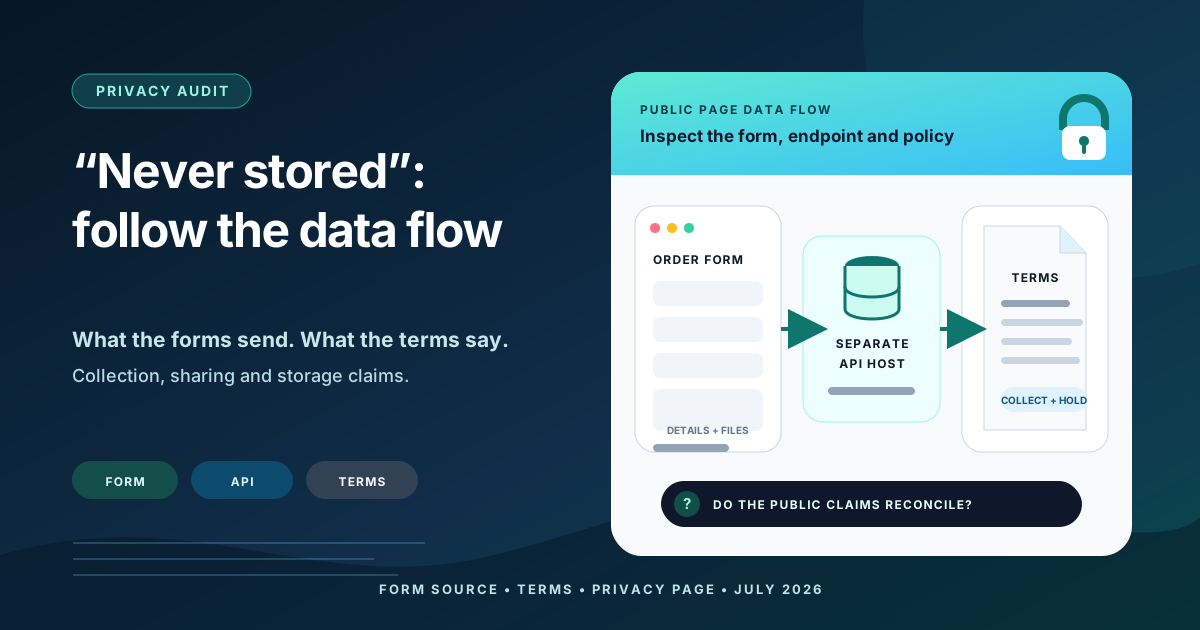
Short answer: SingaporeAssignmentHelp.com says student details are never stored or shared and that all data is end-to-end encrypted. Its own terms say the Agency collects, holds, uses and processes customer data and shares relevant data with the expert. Its submission forms transmit detailed contact, academic and file-upload data to a separate DigitalOcean hostname. Transmission to another hostname is not proof of a separate company or privacy breach, but the public privacy page does not clearly explain the controller, recipients, storage, retention, deletion, international transfers or the external form infrastructure.
Commercial disclosure and method — 15 July 2026: Codingo competes with SingaporeAssignmentHelp.com and commissioned this exact-domain privacy audit. We reviewed visible claims, terms, privacy wording and public client-side form code. We did not submit personal data, attempt unauthorised access, inspect server-side storage or allege a breach. This is a transparency comparison, not legal advice or a regulatory finding.
Privacy Claim-to-Evidence Map
| Public claim or page | Observable evidence | What remains unanswered |
|---|---|---|
| Details are 100% confidential, never stored or shared | Terms say the Agency may obtain, hold and process data for orders, payments and communications | Retention period, deletion event and meaning of “never stored” |
| Data visible only to customer and writer | Terms identify the Agency as controller and the expert as a processor | Which staff, vendors and service providers can access it |
| All data is end-to-end encrypted | HTTPS protects transport to the website; no reviewed public explanation describes customer-held encryption keys or content unreadable to the service | What is encrypted, where, with which key model and at what stages |
| Submit-assignment form | Collects contact, course, deadline, reference style, instructions and files; client code sends them to a separate DigitalOcean app hostname | Operator of that endpoint, storage location, subprocessors and retention |
| Privacy Policy | Focuses mainly on site copyright/use and a minimum age | Controller identity, purposes, recipients, transfers, retention, rights, complaints, DPO and cookies |
1. “Never Stored” Does Not Reconcile With the Terms
The submit-assignment page says details are completely confidential and will never be stored or shared. Similar statements appear on the do-my-assignment page and homepage.
The terms take a different operational position. They say the Agency is the data controller, may obtain and hold personal data, processes it for payments, orders and communications, and shares customer data with the expert or “Principal” acting as processor.
An order service generally needs temporary records to quote, communicate, process payment and deliver work. The problem is the absolute “never stored” wording. The site should instead state what is collected, why, where, for how long, who receives it and how deletion works.
2. What the Public Forms Collect
The submission workflow requests fields including name, email, phone, country, subject, assignment type, deadline, education level, reference style, word count, instructions and file attachments. Client-side code also includes route metadata and a hidden IP field.
That can reveal far more than a generic customer enquiry. A brief may contain a student name or ID, lecturer details, class data, unpublished research, assessment prompts and document metadata. Students should redact all identifiers not essential for a safe quote.
The reviewed form did not visibly place a specific privacy link or consent explanation next to the submit action. A general footer link is less useful than a just-in-time notice explaining why each sensitive field or upload is needed.
3. Form Data Goes to a Separate Hostname
Public page code sends the assignment form to:
prime-management-system-uliky.ondigitalocean.app
File uploads are sent to an upload path on that hostname before the final form submission. A separate hostname may still be controlled by the same operator and DigitalOcean is a common cloud platform. This observation does not prove data leaves a particular country, is retained improperly or reaches an unrelated controller.
It does make the privacy notice more important. The reviewed page does not identify the app operator, hosting region, retention schedule, subprocessor relationship or whether uploaded files can be deleted before an order is accepted.
4. HTTPS Is Not Evidence of End-to-End Encryption
The homepage advertises end-to-end encryption for all data. HTTPS/TLS normally encrypts data while it travels between a browser and the receiving server. NIST defines end-to-end encryption as protection from source to destination so intermediaries cannot access the unencrypted data.
The public site does not describe a system in which only the student and writer hold keys while the Agency and infrastructure cannot read the content. Indeed, order processing and expert allocation appear to require the service to access it. We therefore could not substantiate the stronger end-to-end claim from public evidence. That is not a finding that no internal encryption exists.
5. The Privacy Page Omits Core Operational Details
The Privacy Policy reviewed on 15 July 2026 focuses mainly on copyright, permitted website use and age. It does not clearly identify:
- the legal name and contact details of the data controller;
- data categories and a purpose for each;
- expert, payment, hosting, analytics or communications recipients;
- storage location and overseas transfers;
- retention periods or deletion criteria;
- how to request access, correction, withdrawal or deletion;
- the data protection officer or complaint route; or
- cookie and tracking details.
Singapore's PDPC summarises organisations' data-protection obligations, while its notification guide explains the importance of telling people the purposes for collecting, using or disclosing personal data. These are useful transparency benchmarks. This article does not determine which jurisdiction or statutory regime ultimately applies to the unnamed Agency.
6. The Minimum-Age Wording Needs Clarification
The privacy page says the service is not intended for children under 10 and calls for guardian consent below that age. Singapore's PDPC guidance for children's data advises obtaining parent or guardian consent for children below 13 and notifying both child and parent or guardian.
The site's age threshold does not align cleanly with that current Singapore guidance. That is a policy mismatch, not a legal conclusion. A student-facing provider should state its minimum customer age, contracting-capacity rules and guardian-consent process consistently.
7. Controller Identity Is Still Unclear
The terms call an unnamed “Agency” the controller. The site's copyright notice names All Answers Limited, while its address, structured data and payment infrastructure point to other locations or businesses without explaining their roles. Our company-identity audit documents those signals.
A privacy request needs an accountable recipient. A brand email alone does not tell a user which legal entity must answer, which law governs or which processors need to erase a file.
What This Audit Does Not Prove
- It does not prove that SingaporeAssignmentHelp.com suffered a data breach.
- It does not prove that DigitalOcean or another vendor misuses data.
- It does not prove that uploaded files are permanently stored.
- It does not prove that server-side encryption is absent.
- It does not make a finding of PDPA, GDPR or other legal non-compliance.
It shows that absolute public privacy promises are not reconciled with the site's terms and observable form architecture.
Safer Data-Sharing Checklist
- Remove your name, student ID, email, lecturer details and classmates' data from the brief.
- Strip document comments, tracked changes and hidden metadata.
- Never share university, email, cloud-drive or assessment-platform credentials.
- Ask for the legal controller name, hosting country, recipients and deletion period.
- Ask whether files uploaded for an unaccepted quote are automatically erased.
- Use a minimally necessary extract rather than a full learning-platform download.
- Keep a copy of the privacy notice and written deletion confirmation.
- Prefer institution-approved tutoring or feedback that keeps authorship with you.
FAQ
Does SingaporeAssignmentHelp.com really never store student data?
Its sales pages use that wording, but its terms say the Agency obtains, holds and processes data for operational purposes. The public documents do not define how those statements can both be true.
Is its form encrypted?
The site uses HTTPS, which protects transport to the receiving server. The reviewed public evidence does not substantiate the stronger claim that all data is end-to-end encrypted so the service infrastructure cannot read it.
Is the DigitalOcean endpoint proof of a data leak?
No. It is an observable form destination, not evidence of leakage or misuse. The transparency concern is that the privacy notice does not identify the endpoint's operator, role, location or retention practice.
Can the provider respond or correct the record?
Yes. Codingo will review documented information about the controller, data flow, encryption model, retention or deletion practice and date any material correction.
Related Investigations
- Address and company-identity audit
- Expert profile and AI-portrait audit
- Guarantees compared with the terms
- Review-count fact-check
- Five-minute assignment-provider check
Sources Checked
Useful next steps

About Codingo Editorial Team
Trust & Academic Integrity Research at Codingo, focused on practical academic support, coding explainers, and Singapore university assignment guidance.
View all articlesRelated Articles
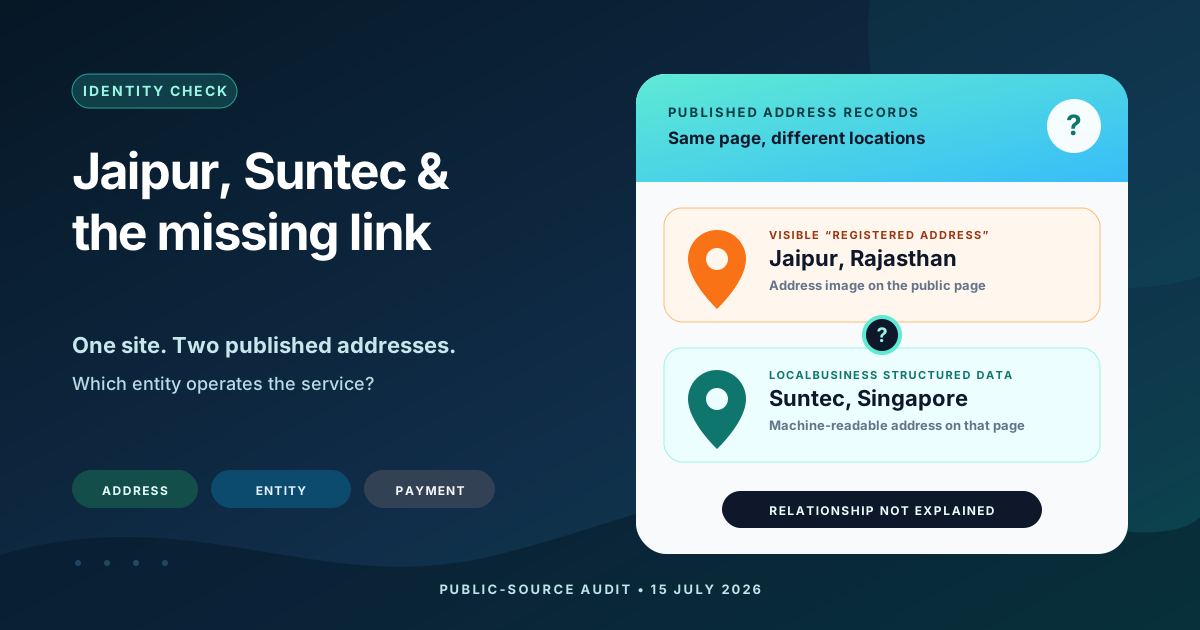
SingaporeAssignmentHelp Address: Jaipur vs Suntec
Why does SingaporeAssignmentHelp.com publish a Jaipur registered address but Suntec business markup? We trace its public company, payment, domain and identity signals.
12 min read
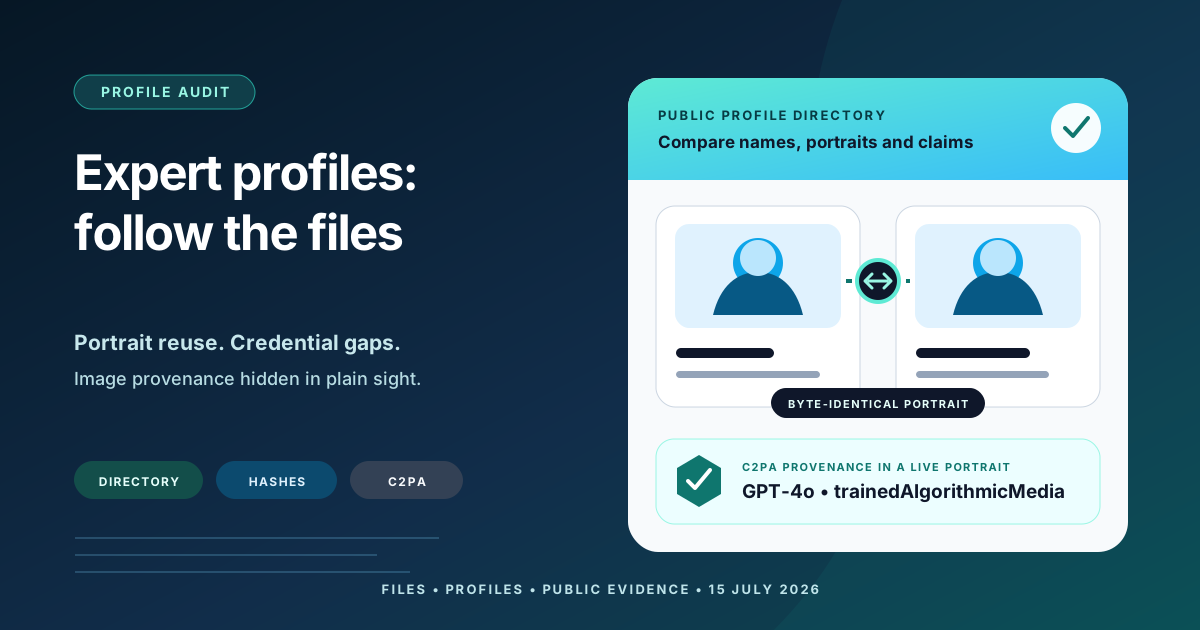
SingaporeAssignmentHelp Expert Profiles: AI Audit
A reproducible audit of 77 public expert profiles, reused portraits, GPT-4o Content Credentials, repeated testimonials and credential-verification gaps.
14 min read
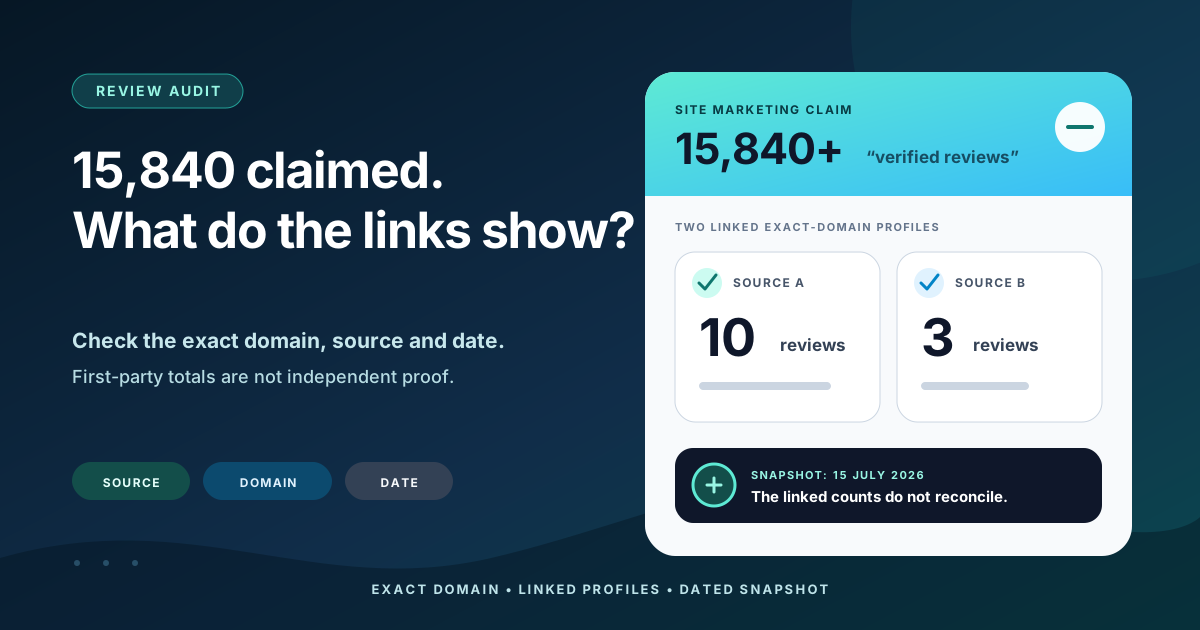
SingaporeAssignmentHelp Reviews: 15,840 Claim Checked
The site advertises 15,840+ verified reviews, but its linked exact-domain profiles showed 10 on Trustpilot and 3 after a Sitejabber redirect on the date checked.
11 min read
Need support you can understand and defend?
Start with the assessment rules. We can scope tutoring, feedback, debugging, editing, source review, or guided drafting while keeping you in control of the final work.