
Contract Cheating in Singapore: Rules & Penalties
A 2026 guide to contract cheating, MOE's published position, NUS, NTU, SMU and SUSS rules, possible sanctions, and safer support boundaries.
Short answer: Contract cheating generally means arranging for another person or service to complete academic work and submitting it as your own. Singapore institutions treat this as academic dishonesty. Consequences depend on the school, facts, severity and disciplinary process; they are not automatically expulsion in every case. A commercial “pass” or refund promise cannot override the assessment rules.
Evidence snapshot — 14 July 2026: This guide uses public university materials and the cited 2021 Straits Times report. Check your current institution, faculty and module rules. This is educational information, not legal or disciplinary advice.
What Counts as Contract Cheating?
NTU’s public academic-integrity guidance defines contract cheating as students getting academic work completed on their behalf, usually for a fee, and submitting it as their own. Payment is common but not essential to the integrity problem: an unpaid friend who writes the assignment can create the same false claim of authorship.
The key elements are third-party completion and misrepresentation in assessed work, whether the task is an essay, code, model, report, test or presentation. Contract cheating is not identical with plagiarism: new material can still misrepresent authorship. A low similarity score does not prove honest authorship, and a flag is not itself a final finding.
Tutoring, Editing and Contract Cheating Are Not the Same
External support is not automatically misconduct. The boundary depends on module rules and who does the intellectual work.
| Type of help | Usually safer when permitted and disclosed as required | Likely high-risk or prohibited |
|---|---|---|
| Concepts | Tutor explains regression, case analysis or an algorithm; student applies it | Third party solves the assessed task and the student cannot explain it |
| Writing | Feedback on a student-created outline or draft; language and citation coaching | A complete paper is produced for submission under the student’s name |
| Coding | Debugging walkthrough, code review and explanation of errors | Someone completes a graded project or live coding assessment for the student |
| Research | Help locating sources and evaluating methods | Fabricated sources, interviews, data, results or ethics records |
| AI tools | Use within the module’s stated rules, with disclosure where required | Hidden use where prohibited, invented process evidence or attempts to bypass checks |
| Assessment access | Student retains all accounts and completes the task personally | Credential sharing, impersonation, remote control or another person taking a quiz or exam |
“Reference only” is not a magic label. If a polished model is submitted substantially unchanged, the school may focus on the actual authorship and use rather than the seller’s description. Keep the final thinking, drafting and explanation genuinely yours.
What MOE and Singapore Universities Say
Ministry of Education position reported in 2021
The Straits Times reported that MOE takes student dishonesty seriously and said ghost-writing and contract cheating are strictly prohibited. MOE added that offenders are subject to disciplinary action, which may include expulsion.
The phrase “may include” matters. It communicates that expulsion is possible, not inevitable. Do not rely on articles claiming one automatic penalty for every institution and case.
NTU’s explicit contract-cheating guidance
NTU’s Wee Kim Wee School academic-integrity page lists contract cheating under academic fraud. It also identifies collusion, false citation, data falsification and facilitating another student’s dishonesty. That breadth shows why originality software alone is not the whole inquiry.
NUS’s central integrity standard
The central NUS Code of Student Conduct requires students to maintain and uphold academic, professional and personal integrity. It identifies cheating, plagiarism and other acts of academic dishonesty as conduct that may lead to disciplinary action. Students should also check faculty and module rules for the specific limits on collaboration, editing and AI tools.
SMU’s academic-violation process
SMU’s Student Disciplinary Code and Procedure applies to its students and defines an academic violation to include cheating in assignments, plagiarism and conduct that creates an unfair academic advantage or disadvantage. The code separates minor and major violations, requires the decision-maker to consider circumstances such as seriousness, harm and prior violations, and provides a range of possible sanctions.
For academic violations, published sanctions range from resubmission, reflection work and grade reduction to zero marks for a component. Major-violation sanctions can include zero for a course, removal from a course, suspension, deferral of a degree or expulsion from the university. This is another reason not to describe one outcome as automatic: classification, procedure and case-specific factors matter.
SUSS uses cumulative, graduated penalties
SUSS’s published academic-integrity material sets out graduated plagiarism penalties, from a warning or grade reduction through zero for an assignment and, for repeated offences, removal from a course or programme. This is a useful public example of why “automatic expulsion” is inaccurate. The exact classification and current process should be checked in the student handbook.
The 2021 ACE Essay Service Account: Precise Reading
The Straits Times story included an unnamed 24-year-old graduate who said he paid S$185 to Ace Essay Service on Carousell to complete an international-business assignment. ACE declined the paper’s request for an interview.
The evidence should not be stretched. It is a newspaper’s report of one unnamed person’s account, not a court judgment, regulator decision or university finding against ACE. It also cannot establish what happens in every engagement with the seller. We cite it because it illustrates the behaviour MOE addressed, not to label ACE illegal or fraudulent.
The cited ACE listing advertises academic consulting and says its order guide must be followed. Codingo’s refund policy calls supplied materials draft samples or reference points. Neither seller’s label can authorise conduct a module prohibits.
For an evidence-led commercial comparison, see Codingo vs ACE Essay Service. For the guarantee terms, see What ACE’s 200% Refund Claim Means.
How Authorship Concerns Can Arise
Students sometimes assume contract cheating is undetectable if text is original. An educator can consider the whole assessment record: source accuracy, reproducible data and calculations, version history, and whether the student can explain decisions.
No signal is infallible. AI detectors and similarity tools have limitations. An honest student should keep the brief, approved-tool rules, notes, calculations, early drafts, source pages and dated versions; document assistance when required; and be able to reproduce and explain the final work.
This evidence supports learning and can clarify misunderstandings. Never fabricate it after the event.
What to Do If You Already Paid for or Received Third-Party Work
Pause the submission. Read the brief, AI policy, handbook and collaboration rules. Separate your work from supplied material, preserve genuine messages and drafts, and never invent notes or alter timestamps. If possible, return to the learning objectives and produce your own response from permitted sources. Ask the lecturer for clarification or use an official extension process where justified.
If an allegation has been raised, follow the notice and deadlines. Ask for the policy and evidence, prepare a truthful chronology, and use available student-support or appeal channels. Consult a qualified Singapore lawyer for legal advice on a specific case.
How to Use Codingo Without Outsourcing Authorship
If you are considering Codingo, start with your own outline, draft, code or error log and the permitted-support rules. Ask for explanations, keep a change record, verify citations and calculations, and write the final assessed response yourself.
Codingo’s published Refund Policy says grades are not guaranteed, describes materials as draft samples or reference points to be reviewed and adapted, and says submitting delivered work as your own can terminate the contract and refund request. Read that policy and the Terms and Conditions before paying. For a written scope discussion, contact Codingo, then compare the proposed scope with your institution’s rules before deciding whether to proceed.
Visit the Academic Integrity Resource Hub for a reusable checklist.
Frequently Asked Questions
Is contract cheating illegal in Singapore?
This guide does not claim a standalone criminal offence applies to every contract-cheating arrangement. It is clearly an academic-policy issue, while consumer, contract, fraud, data and other legal questions depend on the facts. Seek legal advice for a specific matter.
Can I be expelled for paying someone to write an assignment?
Expulsion may be available as a disciplinary outcome, but it is not automatic in every case. Institutions apply their own rules, evidence, severity assessment and procedures. SUSS’s public materials, for example, illustrate graduated and cumulative penalties.
Is it safe if the provider calls the work a “reference model”?
Only if your use complies with the module rules. Submitting a reference model as your own can still misrepresent authorship. Use permitted help to learn, then create and understand your own final work.
Does Turnitin prove contract cheating?
Not by itself. Similarity checking can identify text overlap, while contract cheating may involve newly written material. Institutions may assess sources, drafts, explanations and other evidence under their procedures.
Can a refund guarantee protect me from discipline?
No. A refund is a commercial matter between buyer and seller. It cannot bind a university or reverse a disciplinary decision.
What academic help is normally ethical?
Tutoring, concept explanations, feedback on your draft, citation coaching and debugging walkthroughs are generally safer when your module permits them. Rules vary, so disclose assistance where required and ask your lecturer when unsure.
Sources
- NTU: Academic Integrity and contract cheating
- NUS: Code of Student Conduct
- SMU: Student Disciplinary Code and Procedure
- SUSS Teaching & Learning Centre: Academic Integrity
- SUSS: SD104 Essentials of Academic Integrity
- The Straits Times: Tertiary exam cheats pay others to do their assignments
- ACE Academic Services public profile on Carousell
- Codingo Refund Policy
*Editorial note: Policies are summarised rather than quoted at length. Students should read the current rules issued by their own institution and module before acting.*
Useful next steps

About Codingo Editorial Team
Trust & Academic Integrity Research at Codingo, focused on practical academic support, coding explainers, and Singapore university assignment guidance.
View all articlesRelated Articles
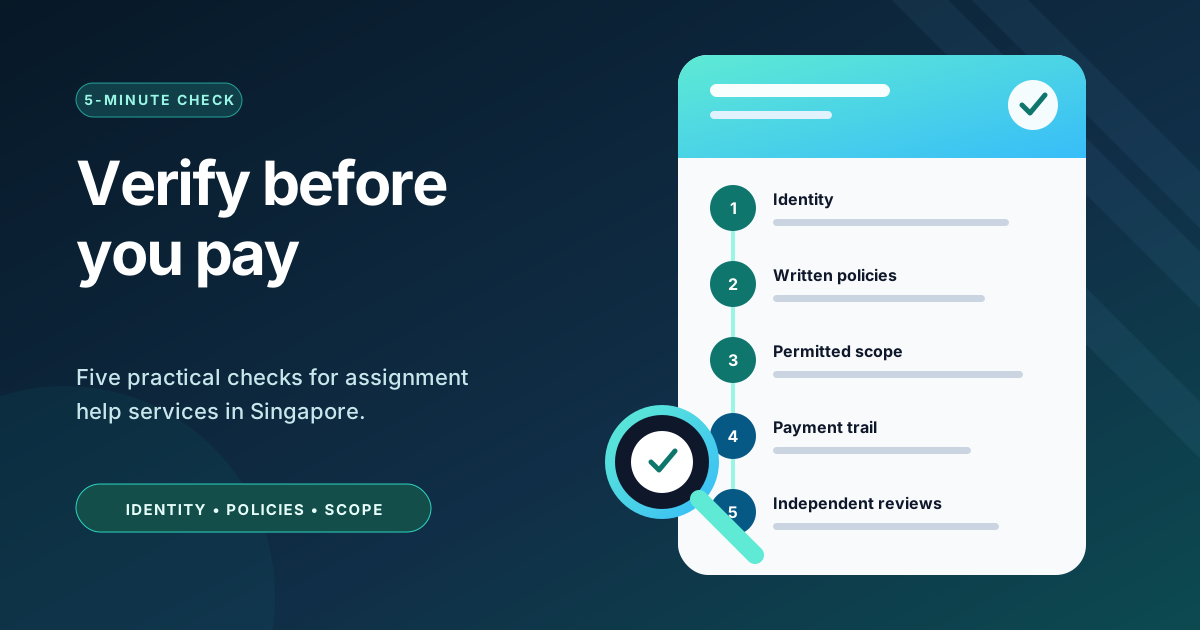
Is Assignment Help Legit? A 5-Minute Check
Verify any Singapore assignment-help provider in five minutes using identity, policy, payment, scope, privacy, review, and integrity checks.
11 min read
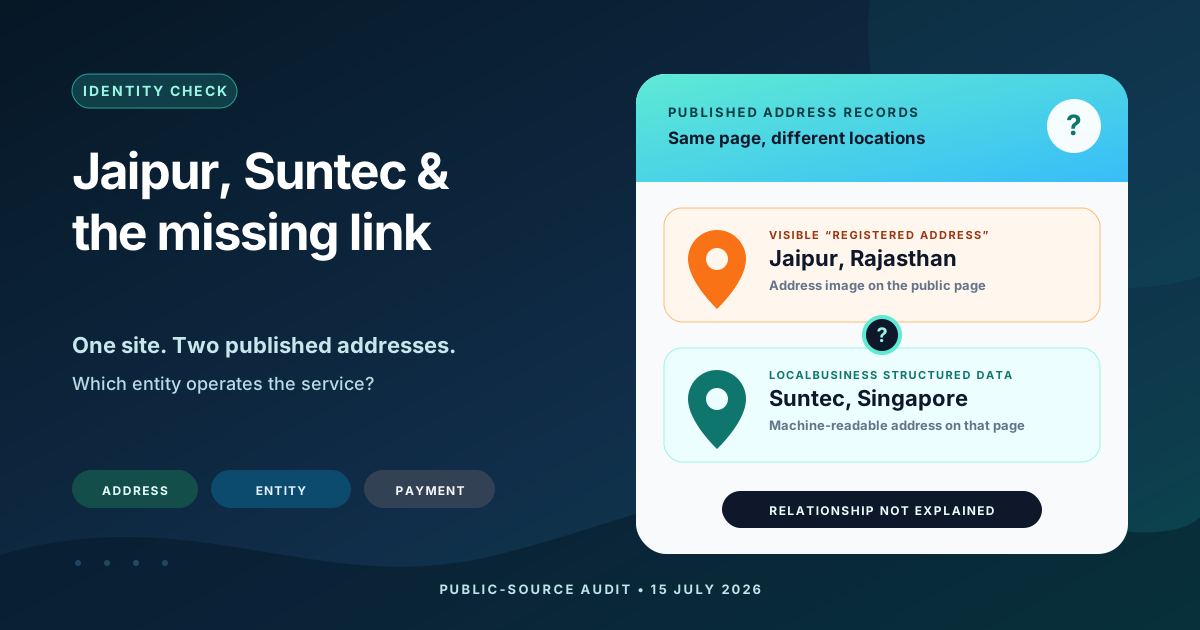
SingaporeAssignmentHelp Address: Jaipur vs Suntec
Why does SingaporeAssignmentHelp.com publish a Jaipur registered address but Suntec business markup? We trace its public company, payment, domain and identity signals.
12 min read
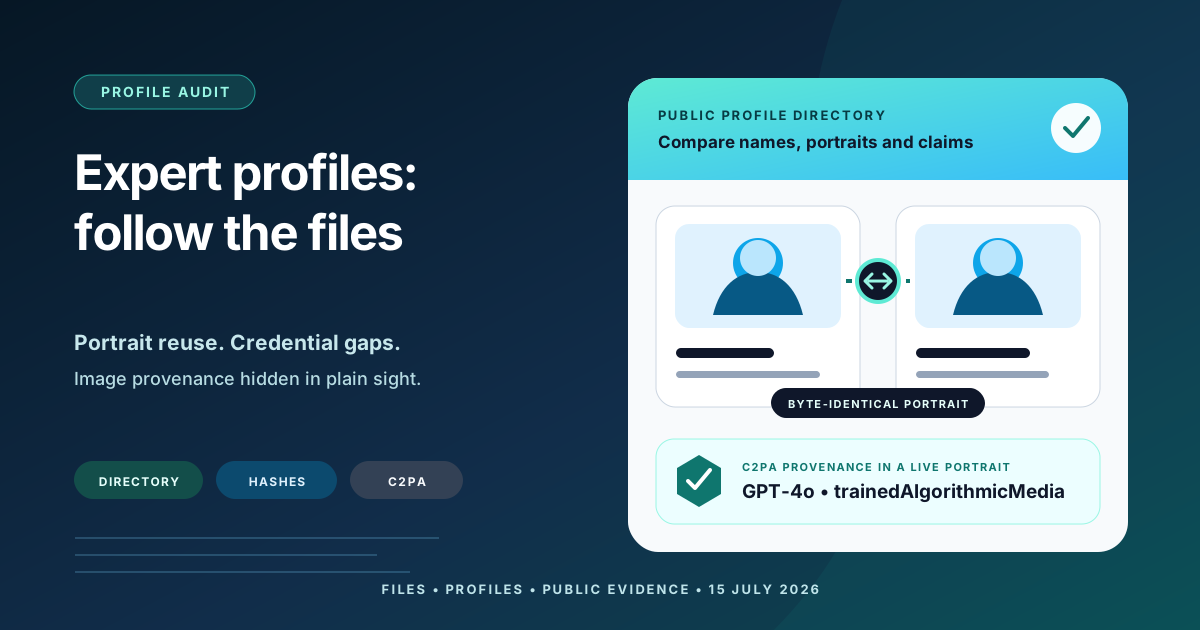
SingaporeAssignmentHelp Expert Profiles: AI Audit
A reproducible audit of 77 public expert profiles, reused portraits, GPT-4o Content Credentials, repeated testimonials and credential-verification gaps.
14 min read
Need support you can understand and defend?
Start with the assessment rules. We can scope tutoring, feedback, debugging, editing, source review, or guided drafting while keeping you in control of the final work.