ACE Essay Service “0% AI” Claim: Turnitin Limits
We examine ACE’s advertised “0% AI” wording against Turnitin’s published limitations, report scope, and the evidence students should request.
Commercial disclosure: Codingo operates in this market and may compete with providers discussed here. This review uses dated public materials; unless expressly stated, we did not purchase or test the provider's work. Linked claims remain open to correction.
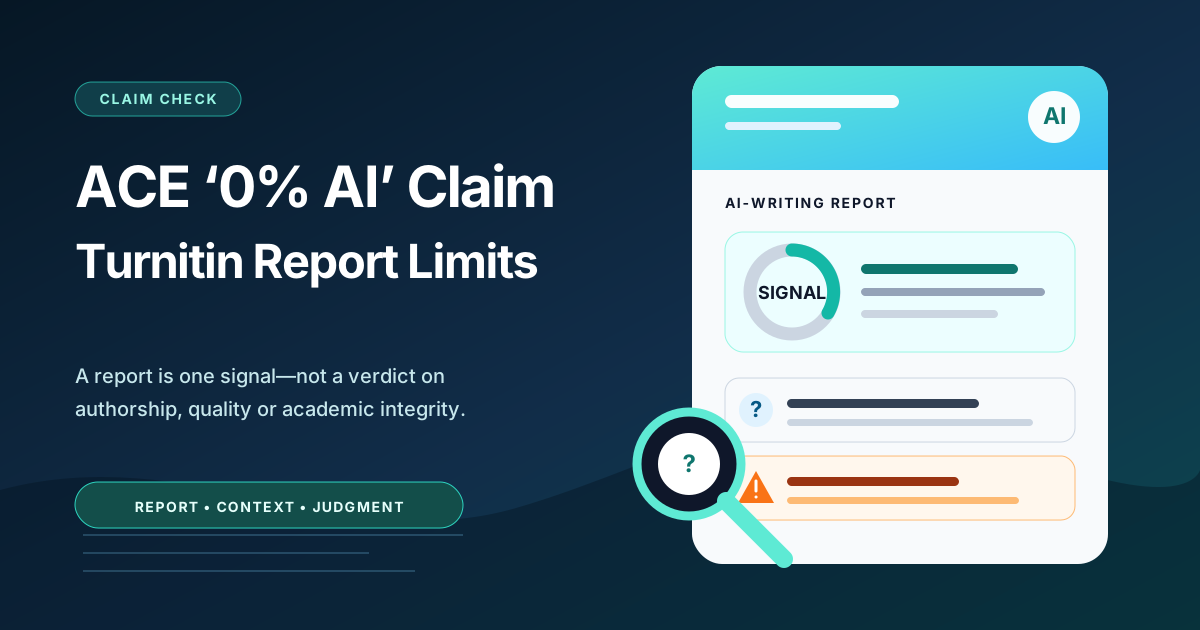
Short answer: ACE currently markets “0% AI”, “0% Plag” and Turnitin reports on its Carousell profile and listings. A Turnitin AI Writing Report can show what Turnitin's model identified in qualifying prose, but Turnitin expressly says its model may misidentify human-written, AI-generated and AI-paraphrased text and should not be the sole basis for adverse action. A zero result is therefore not a certificate of human authorship, academic permission, factual accuracy or safe submission.
Evidence snapshot — 14 July 2026: This article analyses a public marketing claim and Turnitin's own documentation. It does not assert that ACE uses AI, fabricates reports or misdescribes any specific delivery. ACE's Carousell account also displayed a strong 4.97 rating from 7,032 reviews; that positive history should be acknowledged, while detector claims are evaluated on their technical limits.
What ACE Publicly Claims
ACE's profile description included “0% AI | 0% Plag” and “100% Sure Pass or Refund” on the snapshot date. A current listing title promoted a “Registered SG Consultancy” with “0% AI, 0% Plagiarism”, and an ACE-branded Lemon8 post using the same public contact details used language such as “ZERO AI” and “Turnitin Verified Clean”. Some listing text says Turnitin AI and plagiarism reports are included with delivery.
These are ACE's advertising statements. We have not ordered a service, inspected an underlying document or authenticated a private report, so we cannot confirm or contradict the result for an individual order. The right question is what a genuine Turnitin output could establish even when accurately generated.
AI Detection and Similarity Are Different Reports
Turnitin says its AI-writing percentage is different from and independent of the Similarity score. They answer different technical questions:
- The AI Writing Report estimates how much qualifying prose its model identifies as likely AI-generated or likely AI-generated and then AI-paraphrased.
- The Similarity Report identifies text matches against Turnitin's databases, including web pages, student submissions and academic content.
Neither number is a grade. Neither determines whether the underlying argument is correct. A document can have low similarity while relying on invented sources, and original human prose can still fail to answer the rubric. Treat the actual sources, reasoning, calculations and authorship history as separate evidence.
What a Turnitin AI Result Can Show
For an eligible submission, the report can identify passages of qualifying long-form prose that the current model classifies in its detection categories. It can help an educator decide where to ask questions or review drafting evidence. It may also tell a customer what a particular file produced under a particular Turnitin configuration and report version.
That is useful, but narrow. A responsible claim would say: “This dated file generated this report result under this account and product version.” It should not silently expand into “Turnitin proved a human wrote every part”.
If a provider supplies a report, match it to the final filename and content. Record the generation date and whether it is the AI Writing Report, Similarity Report or both.
What a Zero AI Result Cannot Prove
It cannot certify human authorship
Turnitin states that its AI model may not always be accurate and can misidentify human-written, AI-generated and AI-paraphrased text. “0% detected as AI” means the model did not identify qualifying text as likely AI-generated or AI-altered. It does not identify who wrote the document or reconstruct how it was produced.
Turnitin also says scores above zero but below 20% are no longer surfaced as a number because of a higher incidence of false positives; the report shows an asterisk instead. This design choice reinforces that detector output is probabilistic, not a forensic authorship certificate.
It does not cover every kind of content equally
The AI report requires at least 300 words of prose, supports specified file types and languages, and focuses on long-form prose. Turnitin says its model does not reliably detect AI-generated non-prose such as code, poetry, scripts, bullet points, tables or annotated bibliographies.
That limitation is especially relevant where ACE advertises programming, database, presentation and data-analysis support. A prose detector result should not be presented as proof of how code, formulas, diagrams, slide content or spreadsheet logic was created.
It cannot decide plagiarism
Turnitin's current help centre says the service does not determine whether plagiarism occurred. Its Similarity Report finds matching text; an instructor evaluates whether those matches reflect quotation, citation, common language, poor paraphrasing or plagiarism. There is no single “acceptable” or perfect similarity percentage.
A low similarity score does not prove all sources were credited, nor does a high score automatically establish misconduct.
It cannot prove factual quality or rubric compliance
A detector does not validate citations, calculations, case law, code behaviour or whether the answer addresses the task. Check each citation against the source. Run the code and tests. Trace calculations. Map every section to the rubric. These ordinary quality checks matter regardless of the AI indicator.
It cannot grant academic permission
Even perfectly human-written third-party work may breach a university's authorship rules if a student submits it as their own. NTU's WKWSCI academic-integrity page defines contract cheating as getting academic work completed on a student's behalf, usually for a fee, and submitting it as the student's own. It separately includes having another person write an assignment within collusion.
The decisive question is not just “Was AI detected?” It is “Who performed the assessed intellectual work, what assistance was permitted, and was required help disclosed?”
How to Test a “Zero AI” Service Claim
Ask the provider seven precise questions:
- Is “zero AI” a description of the process, a promised detector result or both?
- Which tools are prohibited in drafting, editing, translation, citation and grammar checking?
- Which exact Turnitin report will be supplied, under whose authorised access and for which final file?
- What happens if the institution's own system produces a different result after formatting or revisions?
- Does the claim cover code, tables, formulas and slides despite the detector's stated limitations?
- Is an AI result part of the refund terms, and what evidence and deadline apply?
- How will the service preserve the student's authorship and comply with the module's permitted-support rules?
The answers should be in the order confirmation, not inferred from a listing title. Do not ask a provider to manipulate text to evade detection. The goal is legitimate learning and transparent assistance, not passing a detector.
For broader purchase checks, use the ACE pricing, fees and quote checklist and five-minute provider verification guide.
Better Evidence of Genuine Student Authorship
A student's own process record is more informative than a clean screenshot. Keep the assignment brief, research notes, source annotations, outline, draft versions, code commits, test logs and feedback responses. Be ready to explain why each source, method and design choice was used.
The Ministry of Education describes safeguards beyond automated detection: supervised online examinations, daily interactions and multiple assessment modes that help teachers gauge proficiency and detect uncharacteristic responses. These measures add context that a detector score cannot supply.
If your institution permits external help, define it narrowly: tutoring, feedback on your draft, citation coaching or debugging with a walkthrough. Disclose it when required. The Academic Integrity Resource Hub links current institutional rules, while the Contract Cheating in Singapore guide explains the authorship boundary.
ACE's Rating Does Not Validate—or Invalidate—the Detector Claim
ACE's 4.97 rating and 7,032-review snapshot are substantial positive marketplace evidence. Visible reviews may help assess responsiveness and reported customer satisfaction. They do not change Turnitin's technical limitations, just as those limitations do not show that ACE's customers were dissatisfied.
Keep evidence categories separate: use reviews for reported experiences, platform pages for listing and transaction facts, Turnitin documentation for detector capabilities, and university policies for academic conduct. That separation produces a fairer conclusion than either a promotional slogan or a blanket allegation.
Frequently Asked Questions
Does Turnitin prove that an ACE document contains zero AI writing?
It can report that its model identified 0% of qualifying prose as likely AI-generated in a particular eligible file. Turnitin does not present that output as proof of human authorship, and its model does not reliably cover all content types.
Is a 0% similarity score the same as 0% AI?
No. Similarity and AI writing are separate measures. Similarity identifies text matches; AI detection estimates likely AI-generated qualifying prose.
Does a Turnitin report prove an assignment is plagiarism-free?
No. Turnitin says it does not determine plagiarism and there is no universally acceptable similarity score. Human review of sources and use is required.
Are ACE's zero-AI claims false?
We do not have evidence to make that claim. We explain the limited meaning of detector output and the questions a buyer should ask before relying on a broad marketing phrase.
What is Codingo's position?
Codingo does not guarantee grades and describes supplied material as reference or draft support in its Refund Policy. Anyone considering Codingo should apply the same AI, authorship and evidence questions. For permitted tutoring, editing or debugging, send a redacted brief through contact.
Direct Sources
- ACE Academic Services Carousell profile
- ACE “Registered SG Consultancy” listing showing S$100 and “0% AI” wording
- ACE-branded Lemon8 post using the same public contact details
- Turnitin: Using the AI Writing Report
- Turnitin: Similarity scores and plagiarism
- NTU Singapore: Academic Integrity
- MOE: AI safeguards for online exams and assignments
*Editorial disclosure: Codingo competes in this market. This article does not claim that ACE used AI or that its reports are inauthentic; it applies Turnitin's published limitations equally to every provider, including Codingo.*
Useful next steps

About Codingo Editorial Team
Trust & Academic Integrity Research at Codingo, focused on practical academic support, coding explainers, and Singapore university assignment guidance.
View all articlesRelated Articles
ACE Essay Service Refund Guarantee: What to Check
A source-led review of ACE Academic Services' advertised pass-or-refund promise, Carousell Buyer Protection limits, and academic-integrity risks.
11 min read
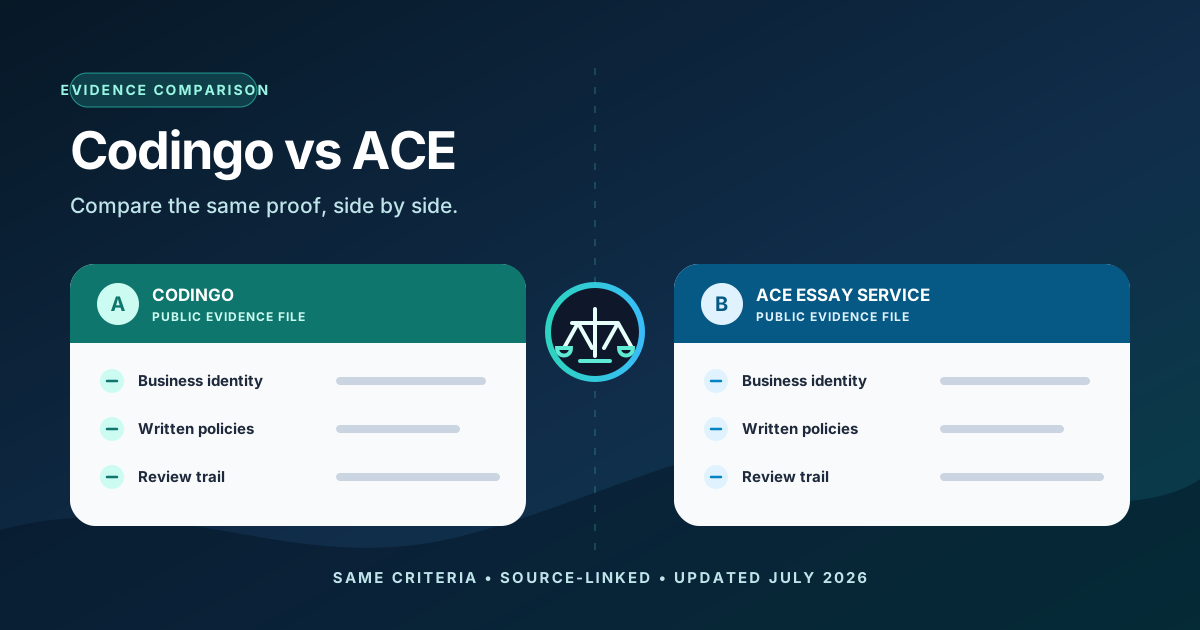
Codingo vs ACE Essay Service: Evidence Comparison
Compare public marketplace records, grade marketing, refund terms, media coverage, and responsible-support boundaries using dated sources.
11 min read
ACE Essay Service Reviews: A 2026 Fact-Check
What current Carousell feedback, a 2021 news report, and a Trustpilot profile with no verified connection do—and do not—establish about ACE Essay Service.
11 min read
Need support you can understand and defend?
Start with the assessment rules. We can scope tutoring, feedback, debugging, editing, source review, or guided drafting while keeping you in control of the final work.